
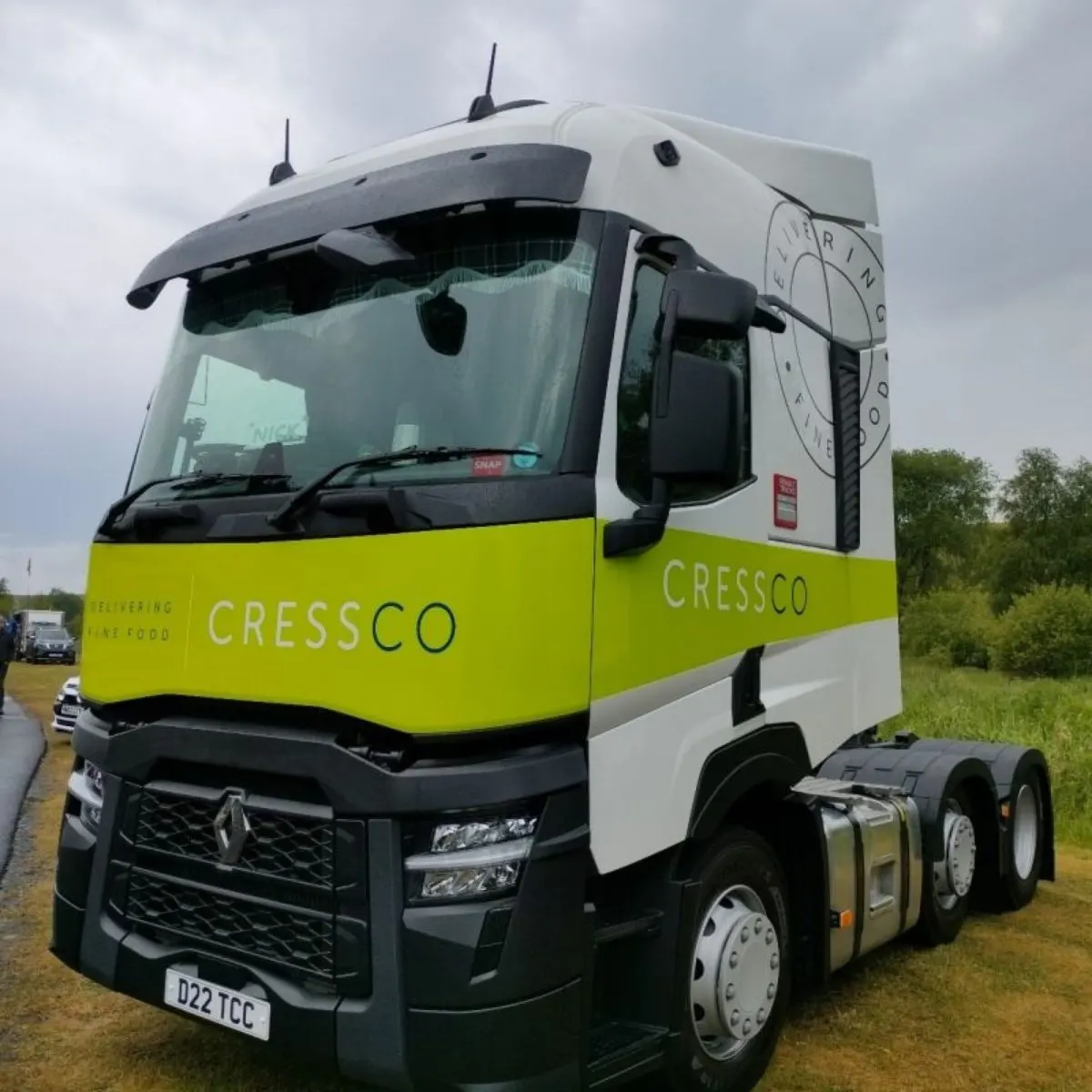
Cress Company is a food distribution and logistics operator with an 85-vehicle private fleet. Dynamon used ZERO to analyse real-world telematics and route data, assess EV feasibility, identify suitable vehicle classes, and design a depot charging strategy aligned to operational demand — giving clear, data-driven insight into which vehicles and routes could transition to electric while minimising operational risk and infrastructure cost.
Key outcomes
- 61% of analysed HGV routes were suitable for electrification using depot-based charging only.
- 900 kW peak demand with managed charging, down from over 3,300 kW unmanaged.
- 6 × 150 kW DC chargers were sufficient to support 36 electric HGVs at Dunfermline.
The challenge
Cress Company operates a mixed HGV fleet supporting time-sensitive food distribution across Scotland and the wider UK. The Dunfermline depot acts as a central hub with high daily vehicle movements and tight delivery windows.
As part of Transport Scotland’s Heavy Goods Vehicle Readiness Fund, Cress Company needed to understand how its Dunfermline fleet could transition to electric vehicles while maintaining service reliability. The fleet included a wide range of vehicle weights, duty cycles, and route lengths. Some vehicles returned to depot daily. Others covered long-distance trunking routes with limited dwell time.
Key challenges included identifying which vehicles were suitable for electrification today, understanding where payload constraints would prevent a direct EV replacement, and determining how much charging infrastructure would be required without triggering excessive grid upgrade costs. Planning needed to be grounded in real operational data rather than generic assumptions.
The solution
Dynamon used ZERO to analyse telematics data from Cress Company’s Dunfermline fleet. The analysis covered 46 vehicles with usable telematics data, representing 36 HGVs in scope. In total, 2,373 duty cycles and over 421,000 miles of driving data were analysed.
ZERO simulated EV replacements across vehicle classes from 7.5t rigid trucks through to 42t tractor and trailer combinations using OEM EV specifications. Each route was assessed against EV range under harsh conditions, energy consumption, dwell time, and charging opportunity.
Vehicles and routes were then assessed to determine duty cycle completion rates using depot-only charging. ZERO also translated vehicle feasibility into charging infrastructure requirements, modelling both unmanaged and managed charging scenarios to understand peak power demand and energy requirements at the Dunfermline site.
Electric vehicle feasibility
ZERO identified strong electrification potential for medium-duty rigid trucks operating from Dunfermline.
- 61 percent of analysed HGV routes were suitable for electrification using depot-based charging only.
- 5t vehicles were constrained by payload and required upsizing to heavier EV classes.
- 12t to 19t rigid trucks showed high route completion rates, reaching up to 99 percent for some vehicle classes.
- 42t tractor and trailer operations were unsuitable due to high average daily mileage and limited charging opportunity.
Route analysis
- 1,454 routes were analysed at the Dunfermline depot.
- 5 percent of journeys were under 125 miles.
- A further 16 percent were between 126 and 185 miles.
- Low-mileage distribution routes were identified as priority candidates for early electrification.
Infrastructure planning
ZERO modelled charging demand based on real arrival and departure patterns.
- 36 electric HGVs could be supported at Dunfermline.
- Typical daily energy demand of 14,987 kWh.
- Worst-case daily energy demand of 16,921 kWh.
- An unmanaged charging approach would have driven peak demand above 3,300 kW.
- A managed charging strategy reduced peak demand to 900 kW.
- 6 × 150 kW DC chargers were sufficient to support the full electrified fleet.
Operational efficiency
- Managed charging significantly reduced grid upgrade risk.
- Charger sharing improved utilisation and reduced hardware requirements.
- Depot-only charging supported the majority of feasible routes without reliance on public charging.
Recommendation
Dynamon recommended a phased electrification strategy aligned to vehicle replacement cycles.
- Start with low-mileage, underutilised vehicles to build operational confidence.
- Upsize smaller vehicles where payload constraints prevent direct EV replacement.
- Retain alternative fuels such as HVO or CNG for high-mileage tractor and trailer operations in the near term.
- Deploy managed DC charging at Dunfermline to control peak demand and minimise infrastructure costs.
- Review and refine route allocation as EV experience grows.
By grounding decisions in real telematics data and realistic charging scenarios, ZERO provided Cress Company with a clear, actionable roadmap for fleet electrification. The result is a transition plan that protects service quality, controls cost, and supports long-term decarbonisation goals.