
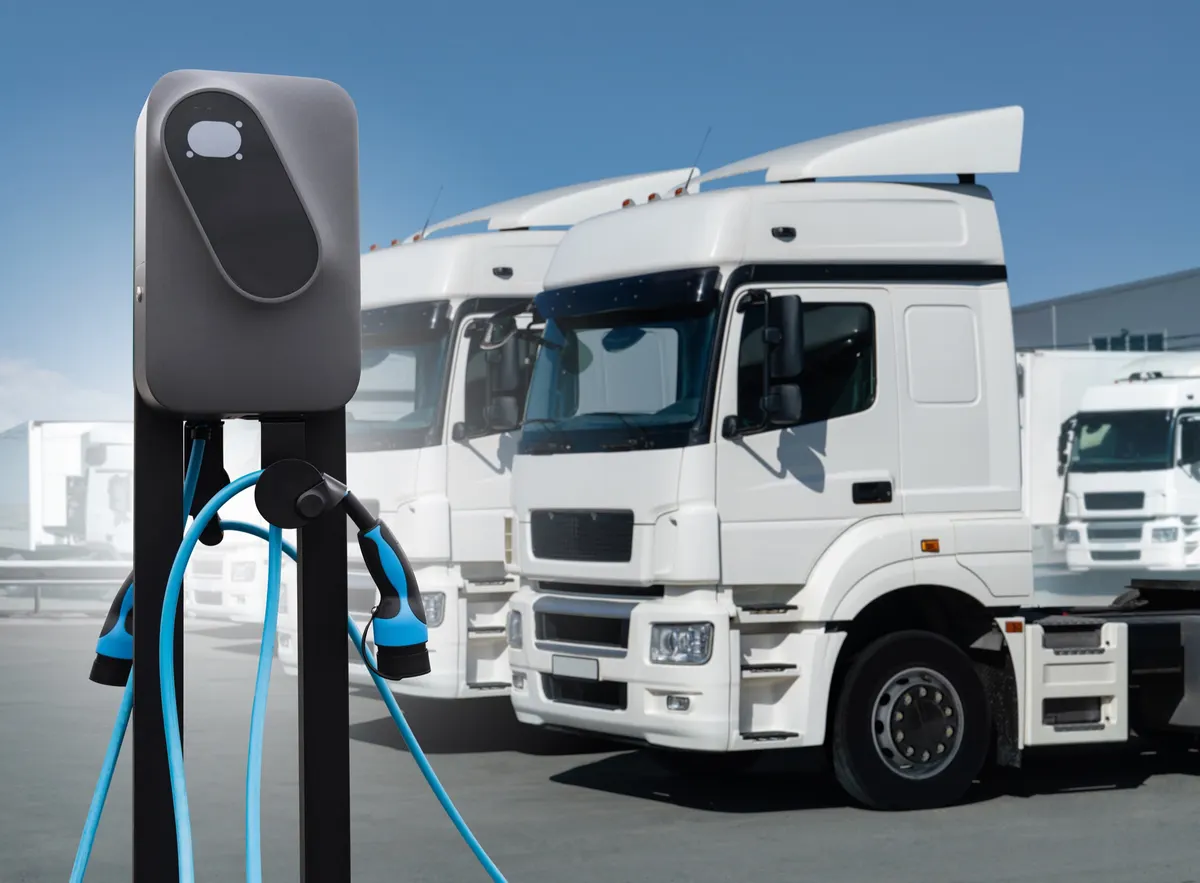
ZERO gave a national parcel delivery business clear insights into electric truck performance — recommending the most suitable 42-tonne electric HGVs for single-deck and double-deck trailer operations across different routes, so the fleet could deploy with certainty and cost-effectiveness.
Key outcomes
- Urban range up to 284 miles (single-deck) and 269 miles (double-deck) under harsh weather — with around 30–32% of battery energy lost to aerodynamic drag.
- Motorway range up to 171 miles (single-deck) and 148 miles (double-deck) under harsh weather — with 62.7–69.5% of battery energy lost to aerodynamic drag.
- 6 tractor configs simulated at 315 kWh, 420 kWh and 525 kWh battery sizes for both trailer types on urban and motorway Synthetic Telematics routes.
The challenge
A national delivery fleet had successfully transitioned nearly 5% of its small panel van fleet to electric vehicles across multiple depots, finding that step relatively straightforward. To push decarbonisation further, it needed to explore and compare the performance of 42-tonne electric tractors with single-deck and double-deck trailers across different urban and motorway duty cycles.
With a wide-ranging operation and diverse routes, the fleet needed insight into the most suitable electric trucks for its needs — and how double-deck trailers would affect vehicle range.
The solution
Dynamon’s approach focused on determining real-world range across diverse scenarios, understanding the impact of aerodynamics and weather, and assessing how driving styles and speed influence e-HGV efficiency and range.
ZERO’s Synthetic Telematics feature generated one urban route and one motorway route to assess single-deck versus double-deck trailers across operational scenarios. ZERO also simulated six tractors with battery sizes of 315 kWh, 420 kWh and 525 kWh — each towing both trailer types on the generated routes.
The results
On an urban duty cycle, the single-deck vehicle demonstrated a range of up to 284 miles under harsh weather conditions, with 30% of battery energy depleted due to aerodynamic drag. The double-deck vehicle reached up to 269 miles under similar conditions, with 32.1% of battery energy depleted by aerodynamic drag at lower urban speeds.
On a motorway duty cycle, the single-deck vehicle reached up to 171 miles in harsh weather, with 62.7% of battery energy depleted by aerodynamic drag. The double-deck vehicle achieved up to 148 miles, with 69.5% depleted — largely from increased aerodynamic drag at higher speeds.
Simulation results showed the substantial impact of aerodynamic drag on motorway driving for both vehicle types, significantly reducing the distance covered compared with manufacturer-stated range.
- “This pioneering work proved the viability of electric HGVs, and it’s an example to all fleets that you can use software to solve the most complex decarbonisation and operational challenges.” — Angus Webb, Dynamon
Using ZERO, the fleet obtained recommendations for selecting the most suitable electric HGV trucks to operate both single-deck and double-deck trailers across different routes — providing certainty to deploy electric trucks that can reliably fulfil the operation in a cost-effective manner.