

The Seven Deadly Sins of Trials. Part 1 of this article (/resources/why-smart-fleets-do-trials-part-1/) explained why logistics companies that purchase to minimise total cost of ownership (TCO) gain a significant competitive advantage — and why fuel, typically 73% of operational expenditure and 56% of TCO, should be the priority.
Real-world trials are used to identify vehicle hardware solutions (such as tractors, trailers, tyres, aerodynamics, driver aids, and more) that reduce fuel consumption and therefore TCO. However, trials must be conducted with a rigorous scientific method to ensure that accurate conclusions are drawn and the correct purchasing decisions are made. Unfortunately this is quite often not the case, and logistics companies waste a lot of resources with trials and use their invalid results to make poor purchasing decisions.
This second half looks into the common mistakes which lead to poor trial design and execution, and makes suggestions on how to conduct a rigorous scientific trial that will lead to the holy grail of minimum TCO.
The seven deadly sins of trials (and how to avoid them)
So what are the common mistakes that lead to incorrect conclusions in trials, and how can they be avoided?
1. Not enough vehicles
The large fuel consumption variability between vehicles performing similar operations means that some vehicles will have low fuel consumption, some moderate, and some high. If a fleet is trialling a solution on a very small number of vehicles and intends to compare the performance with the rest of the fleet, there is a large chance that the choice of vehicles will have a larger influence on the measured fuel saving than the hardware being trialled.
As the number of vehicles in the trial increases, the chances of having an even spread of low, moderate, and high fuel consumption vehicles significantly increases. With more vehicles you are more likely to measure the effect of the hardware you are trialling. However, this means your trial will be more expensive for either you or the hardware supplier, as you will need more of the hardware to trial.
2. Bad grouping
In most fleets it is possible to group the vehicles into categories, such as depot location, vehicle make, model, cargo, or operation type. All of these factors will strongly influence the fuel consumption of vehicles. For example, at a depot location, vehicles will experience specific road conditions, terrain, maintenance, local climate, and driver management — all of which affect fuel consumption.
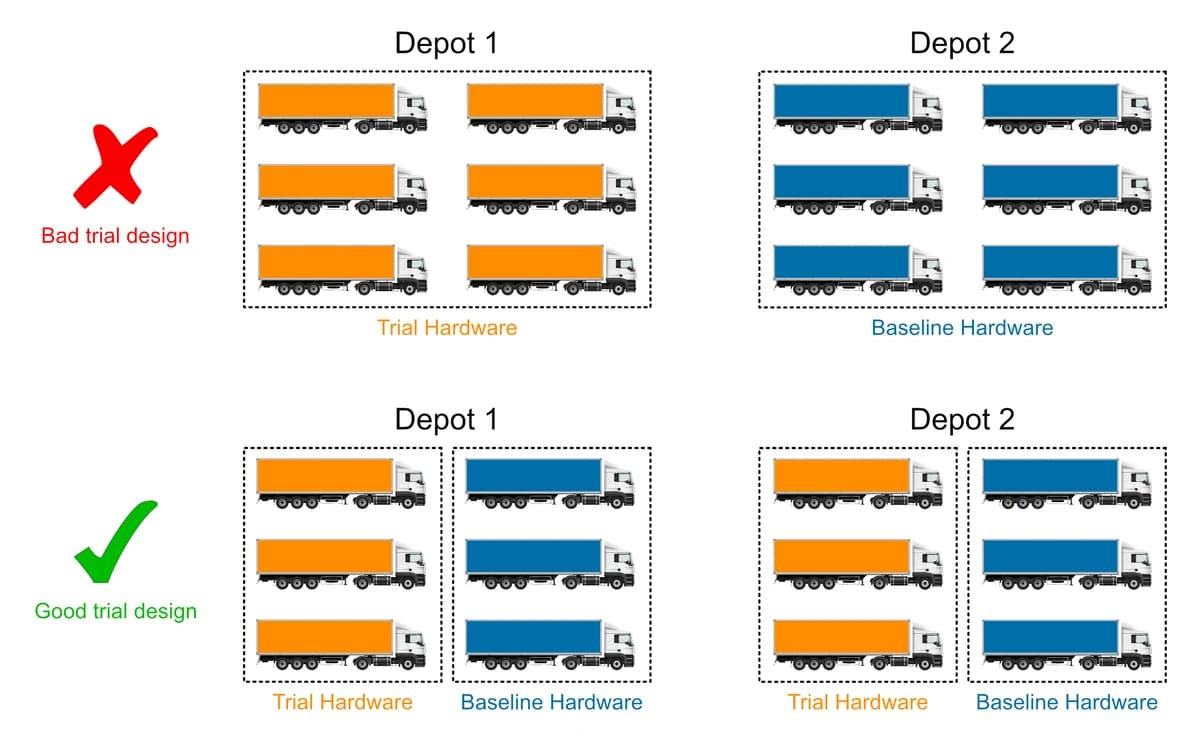
When trialling new hardware it is common to do it on a specific group of vehicles or at a specific location. If these trial vehicles are being compared to vehicles at a different location or with vehicles of different make or model, the measured fuel saving will not only be influenced by the trial hardware, but also by vehicle category. Therefore, vehicles from one group should not be compared to vehicles in other groups.
It is better to spread the trial across multiple groups and make direct comparisons only between vehicles in the same group. This significantly reduces the chance of inaccurate fuel saving measurements and gives a better indication of the hardware performance across your fleet operation. The figure below describes the difference between a good and a bad trial design across two vehicle groups such as two depots.
3. Bad data analysis
Most logistics companies use telematics and this makes recording fuel consumption significantly easier and more accurate. However, there is a lot of information hidden in telematics data that logistics companies do not, or cannot, access during trials. It is important to monitor all variables that influence fuel consumption such as speed, acceleration, gross vehicle weight, tyre pressure, road gradients, weather, traffic, and more.
If a vehicle experiences abnormal conditions during a trial which drastically influences the measured fuel saving, then this data must be removed — not because you are trying to fix the result, but because you want to measure the effect of the hardware you are trialling and not a rare circumstance that caused the fuel consumption to change. Data filtering and cleansing is therefore crucial to a successful trial outcome.
4. Making more than one change
This is a very common mistake made by many fleets. It is absolutely crucial to control what has changed on a vehicle, so you measure the fuel saving for the hardware you are interested in. The most common example occurs when trialling new vehicles. You may want to measure how much more fuel efficient a new vehicle is to understand if or how quickly to introduce it to your fleet.
However, for example, the new vehicle will also come fitted with the latest tyre technology designed for maximum fuel efficiency which will likely differ from your fleet tyre policy. This may also be the case for aerodynamics and other technology that improves fuel efficiency. If you want to know how the tractor unit will perform in your fleet, it must be using your tyre policy and your aerodynamic specification. Otherwise the effects of these other devices may make it seem much better than it is — perhaps leading to a badly informed purchasing decision.
5. Not knowing what the expected fuel saving should be
This is challenging but extremely important. Fuel saving happens for a physical reason — there is no magic to it. Fuel is saved if the load on the engine is reduced or the engine efficiency is improved (how fuel is converted to mechanical energy). For example, tyres, aerodynamics, weight saving, speed limiting, and better lubricants can save fuel by reducing the torque on the engine. Fuel additives, hybrid technology, and improved engine design can save fuel by increasing engine efficiency.
The influence of all of these solutions is measurable in a laboratory environment, such as at a proving ground. How these perform in a real-world operation is where the vast complexity arises. A predictive data analytics service, such as that offered by Dynamon, is the most reliable means to understand what the fuel saving should be for any hardware solution in a specific fleet operation. The real-world trial should then be used to confirm the predictions from the analytics and influence the final purchasing decision that leads to reduced fleet TCO.
6. Unnecessary trials
Following on from the point above, many logistics companies trial hardware solutions that they shouldn’t because they are not aware of this in advance. This is a waste of resource, and may even lead to a wrong purchasing decision — increasing fleet TCO in the long term.
Additionally, where there are many potential hardware options, such as when considering tyre choice, real-world trials are a very inefficient and expensive means of narrowing down the choice. Again, this is where predictive data analytics such as Dynamon’s Tyre Analytics should be used to identify the optimum tyre choice without the need for large-scale trials. If necessary, a real-world trial can be used to confirm the analytics and influence the purchasing decision.
7. Percentage changes in MPG
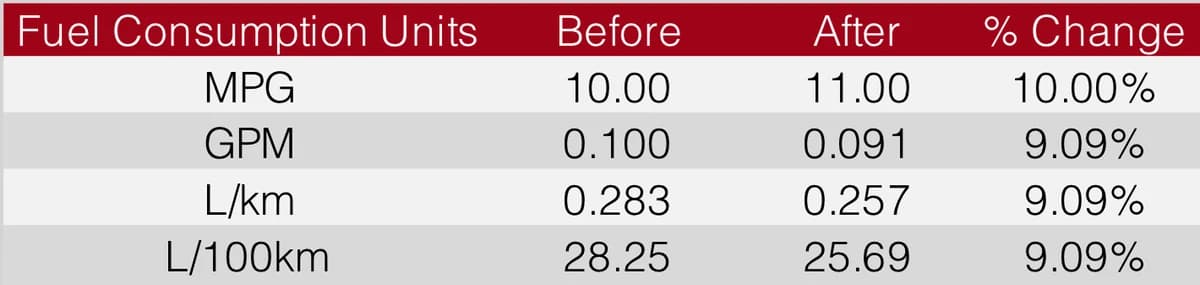
And lastly, a very simple but important point. Beware of how you calculate percentage savings and the use of MPG. Fuel savings should be reported in units of “fuel per distance”, not “distance per fuel”. See the table below.
A 10% increase in MPG means you can travel 10% further on a fixed amount of fuel, but it does not result in a 10% fuel saving. If you want to drive the same distance and know how much fuel you will save, you need to use gallons per mile, litres per km, or litres per 100 km. Therefore, in this example, a 10% increase in MPG becomes a 9% fuel saving — or a 9% reduction in gallons per mile, litres per km, or litres per 100 km.
So to conclude…
Trials are extremely important. They enable logistics companies to identify hardware solutions that minimise total cost of ownership. A logistics company that operates a minimum-TCO fleet has a significant competitive advantage as it will make greater margins and win more business — benefiting its employees, shareholders, customers and the environment.
TCO is mostly influenced by fuel cost and therefore logistics companies need to identify hardware solutions that minimise fuel consumption. However, due to the complexity of real-world vehicle performance, trials that measure fuel consumption often have misleading conclusions and can lead to the wrong purchasing decision.
It is extremely important to design and manage a trial properly, and to perform the correct data analysis. Using predictive data analytics, such as that provided by Dynamon, significantly increases the likelihood of making optimum purchasing decisions and eliminates the wasted resources of poorly executed trials and lost margins from incorrect procurement decisions.
Dynamon’s Precision Trial Analytics helps fleets design rigorous real-world trials and interpret telematics correctly — so purchasing decisions reduce TCO rather than rely on misleading results. — Dr Angus Webb, CEO, Dynamon